Cynthia Vaskis
SLM521 Spring
2004
Web Quest Assignment
File: webqstop.htm

To
boldly go where no Robot has gone before…
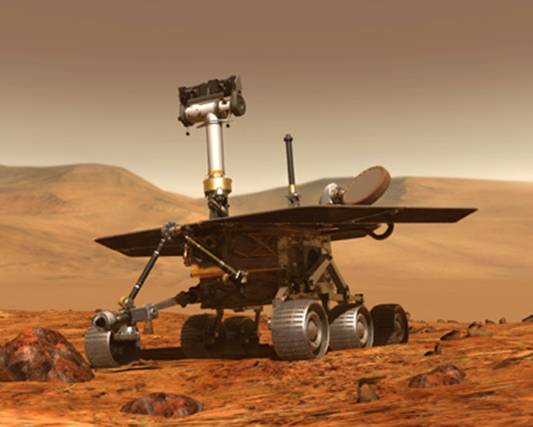
Mars rover Spirit
(artist’s drawing)
Who is this Web Quest for? This Web
Quest is for High School 11th and 12th grade students who
have a basic understanding of coordinate systems (3D Cartesian and Polar) and
trigonometry.
See the Teacher’s Page
for suggestions about using the Web Quest.
Introduction - Robotics in Space Exploration
The purpose of this Web
Quest is to learn about the use of Robotics in space exploration today and where
robots are planned to be used in the future space exploration. The student will study the identical Mars
rovers “Spirit” and “Opportunity” as examples.
The Web Quest will have the students learn about the Mars rovers’
mission, or purpose, and how they operate, communicate with Earth Mission
Control, move, collect samples, and how they obtain, store, and use
energy. The students will be asked to
explain how the Mars rover makes decisions about moving across the land
safely. The student will be asked to
identify the types of devices on the Mars rover that help it perform scientific
experiments and what sensor data it collects to help carry out its
mission. The students will be asked to
identify parts of the Mars rover that most likely need math rotation computer
programs to calculate how far to move or rotate that part.
The student will consider
the environments that robots are working in and where they may be in the future
either on the Moon in human habitats, returning to Mars, or on deep space explorations. President Bush’s plan for space exploration
includes robotic companions for humans on Moon missions and to continue to send
robots to Mars.
Another area where robots
may be used in the future is in military robotic armies to replace some tasks
that are more dangerous for people.
Unmanned weapons have already been used to seek out targets. Will sabotage robots be used too? Will robots be used to fight wars and
determine the outcome of our country’s military history? Should we allow our government to put robots
in space controlling space weapons?
These are some of the questions the students should discuss as a group
after looking at the material this Web Quest presents.
We will briefly look at
whether Artificial Intelligence programs can make robots more useful and allow
them to reason about their environment.
We will discuss whether or not robots can think for themselves and
decide if they want to follow human commands.
What if some crazy programmer decided to create a routine for robot rebellion? The area of computer programming that deals
with encoding human reasoning into software is called Artificial
Intelligence. We will look at the
possibility of the robot reasoning about its environment and taking action as a
human. Will robots change the way you live your life in the future?
The Task – Understanding how robots
are used in space exploration
Our goal in this Web Quest
is for the student to see where and how robots are being used today and learn
about plans for them in the future. Based on the information they gather from the
Web, the student will be asked to evaluate whether the future plans for robots
will be helpful to society or whether their purposes pose a threat to society. Soon, these students will be able to vote for
or against political issues such as what research should be funded by the
government for robotics development.
Does the government have plans for robotic soldiers or are they just
dreaming?
Today, many industries use
robotic machines. Some of these areas are
in manufacturing, food production, medical research, entertainment, children’s
toys, the military, and in space exploration.
The student will focus on just one area of space exploration. The student will review the Mars rover
capabilities and their structural parts descriptions. Based on information on the linked web sites
for each part of the Web Quest, the
student will be asked to understand how the Mars rovers work and apply that to
the task of designing, and possibly building, a robot of their own.
The student will read what
President Bush said his plans are for robots in the future. The student will be asked to decide if these
plans are good or not. Then, the student
will look at the military goals for robot armies in the future. The student will also be asked if they think
some people are planning to use robots in a way that may be harmful to society
and why they think so. At the end of the
process of searching through the sites, the student will be asked to design a
robot of their own, possibly one for the Moon habitat.
The Process – Learn about robots in
space and create your own robotic design
Part 1: The
student learns about the Mars Mission and the rovers named Spirit and
Opportunity. The student answers
questions and identifies the general design areas such as the robot’s purpose
or mission, its structural design, its mobility, its power source and overall
how that the robot works to carry out its mission.
Part 2: The student will learn about where robotics
is used on other space programs such as the Space Shuttle and the Space
Station.
Part 3: The student will seek out the signs of where
robots might be used in the future as deep space explorers (to Mars and
beyond), as Moon habitat companions and workers, and the possibility of U.S.
military robotic armies. The student
becomes familiar with the government’s (President Bush’s and NASA’s) plans for
robotic space exploration and in particular future missions to the Moon with
humans and robots as well as continuing to explore Mars. Have the students hold a group discussion
about whether the country should proceed in this direction or not after they
have each completed this part.
Part 4: The student is to become familiar with what
people here on Earth are doing to design and build robots for possible space
exploration use and what NASA is doing to encourage those people to create new
designs possibly for future space missions.
Part 5: The student is to define or design their own
robot on graph paper or use a drawing tool on the computer. They should describe how each part of it
operates, how it moves, sees, and interacts with the world. Use LEGO’s robot
design kits if available.
Part 6:
(optional or extra credit) The student will read about
the US Space Program History and answer some questions.
The Resources

Robotics Education Project - Home
http://robotics.nasa.gov/
See the large
list of related Resources Web Page. – Click on this to go find many related
resources. Some of these are mentioned
on the Process Part pages were they will be most useful.
Related Web Quests
Mars Quest – Take a tour of
the rovers on Mars and see what they see.
Explore Mars, see Mars mysteries, and even drive a rover. Rover images and a fly over Mars are also
there. Learn about the mission on Mars
happening right now.
http://www.marsquestonline.org/index.html
Mars Team Online – An abridges/Guided Tour – NASA’s Mars Team Online (MTO)
project gives a tour (takes about 10-15 minutes to cover it). It shows you what is new in the News about
the Mars mission and gives a description of Mars and a history of the
spacecraft that have visited Mars in the past.
It even gives you a way to chat with people at NASA.
http://quest.arc.nasa.gov/mars/tourguide/start.html
Robots: New Age Assistants
– This Web Quest lets you design your own robot for an exploration trip to the
Antarctic. It helps you to discover how
to design and build a robot for an extreme environment.
http://www.msu.edu/~wetherb1/robots.html
A City in Space
– Be a colonist on the international Space Station (ISS) by completing
activities about living in space.
http://projects.edtech.sandi.net/mission/iss/index.htm
Space Station Phyve
– A Web Quest for high school physics that explores the universe as a real
scientist would do in a research area.
http://www.geocities.com/r_deruvo/
20
Reasons to colonize Mars - A high school science WebQuest
– This Web Quest has the students find information that supports or not the
colonization of Mars and they gives their 20 reasons for doing so or not to do
so.
http://www.the-solar-system.net/webquests/colonize-mars-webquest.html
Solar
System WebQuest
- The Web Quest has the students create a puppet show about mining an
asteroid where they need to do research about space exploration.
http://www.the-solar-system.net/webquests/asteroid-mining-webquest.html
NASA Quest – This is a site
that introduces the student to what NASA is doing in space exploration and
points them to the people and subject matter that explains what NASA is
currently doing in space.
http://quest.arc.nasa.gov/about/index.html
NASA Quest Archives – This is the Mars Team
Online site that links to the space exploration site in the NASA Web
Quest. There are some extra things not
found in the NASA site such as background information on the Mars mission, TV
images from Mars and a chat area.
http://quest.arc.nasa.gov/mars/
Additional space related web sites
Living
in Space – NASA’s description of living in space
on the Space Shuttle and the ISS.
http://spaceflight.nasa.gov/living/index.html
Evaluation
The student will be
evaluated by how much he/she has gained in knowledge of the Mars Mission and
rovers. The students should be able to
discuss whether or not the
See the Evaluation
Rubric Table to evaluate the student’s success in performing the Web Quest.
Conclusion
The students should be able
to identify the main parts of any robot they may encounter in the future and understand,
in general, their capabilities. Robots
are machines built to behave like humans or to take the place of humans in
specific, and usually dangerous, environments.
Where will robots be in the future?
The military wants them to fight our battles for us. President Bush has plans for them on future
Moon and Mars explorations. The students
should have been able to grasp the significance of the plans for where robots
will be in the future. They will soon be
old enough to vote on whether robots “boldly go where no robot has gone
before”.
The Teacher’s Page
See the Teacher’s
page for access to each Process Parts, Evaluation Rubric Chart, extra Web
links, download (ahead of class) video information and comments about question
answers.