Mona Lisa Theories
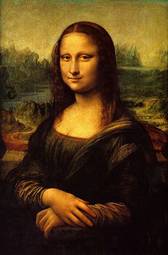
Leonardo Da Vinci’s
Mona Lisa (1503-1519)
Art is a noteworthy subject not only for
its skill and craft, but also because the meaning behind artworks sometimes
varies. Art historians, critics, even everyday
people have their own interpretations of artwork. In a broad spectrum, what is the meaning
behind 20th Century Abstract Art?
Obviously there is something that influences the erratic forms commonly
shown in contemporary artworks, yet why do some critics believe abstraction is
merely swirls and shapes with no intention?
Opposing viewpoints have persisted for centuries.
One of the most renowned, controversial artworks in history is Leonardo
Da Vinci’s Mona Lisa (1503-1519),
created by oil on poplar. Having a
16-year prolonged duration, Da Vinci finally finished his masterpiece shortly
before his death in 1519. The Mona Lisa was created during the Italian
Renaissance; however, it did not emerge prominent until the 19th
Century. One of the major reasons it
gained popularity was not because of Da Vinci’s skill and craft, but rather the
various interpretations of its underlying meaning. Some historians believe it is more than what
appears ranging not only from the figure’s personality, but also to the
sexuality. Others believe it is a mere
portrait of a female, exactly what it appears.
Leonardo Da Vinci used much skill and
craft to create this stunning masterpiece; yet to this day, there are critics
who debate over a “hidden meaning” in his work.
Obviously there is no existing proof as to which theory is correct, but
it is important to be aware of the vast possibilities. Furthermore, it is important to understand
one of the most notable artworks in history, Leonardo Da Vinci’s Mona Lisa.
Take a look at the two websites provided, then compare and contrast
the information. Finally, answer the
questions below.
http://ezinearticles.com/?Analysis-of-the-Mona-Lisa-Painting&id=832462
1. Explain,
in your own words, a brief description (3 to 4 sentences) of the Mona Lisa.
2. Based
on your own observation, what do you notice about Da Vinci’s artwork?
3. After looking
at both websites, what are some similarities between the two theories?
4.
Contrary to question 3, what
are some of the major differences between the two websites?
5.
In your opinion, is there a
way to prove (other than circumstantial evidence) the true meaning behind
Leonardo Da Vinci’s Mona Lisa?
Follow-up
Activity:
Do you know of any other controversial artworks? If so, write down a brief description in your
sketchbook. If you are not aware of any,
perhaps list a few possibilities of how a particular artwork could be
considered controversial.