Greek Mythology: A Travel
Agent’s Webquest
Created by Joanna
Smith, SLM 505, Spring 2004
Introduction
During ancient times, Greeks
and Romans relied on a religion based on polygamy. Believing in many different
gods and goddesses, these people dedicated their lives to making these deities
happy and proud of their people on Earth. Each god or goddess had very specific
powers, abilities, weaknesses, and areas of domain. It wasn't easy keeping
these gods happy! According to the Greeks, their gods were easily angered and
took their wrath out on each other as well as the people of Earth. Find out
more about these ancient
Greek's religion!
The Task
Your task is to create a
travel brochure for people who are interested in visiting Mt. Olympus and its
surrounding domains. Each group member is a part of a tourist committee who
must try to improve the tourist population of Ancient Greece. Commerce is down
and the best way to jump start the economy is to get outsiders in, visiting,
and spending money! Each of you must select one area of interest in Ancient
Greece and gather information that will enable your group to come together and
create an award-winning (or "A" winning!) brochure. You and your
group are to study the websites I've suggested and gather information in order
to do the following:
- List at
least six interesting "tourist spots"
 You might want to think about: *domains
that the gods ruled (ie. the Underworld)
You might want to think about: *domains
that the gods ruled (ie. the Underworld)
*historical/mythological buildings (ie.
Midos's labrynth)
*mythological geographic formations (ie. Styx River)
- Describe
who rules each specific area you listed
For
example, Poseidon rules the Sea, Zeus rules the Sky, and Hades rules the Underworld.
- Provide
a short description of the ruling god
Things
that you should mention: *special abilities (ie. Aphrodite could make people
fall in love)
*weaknesses (ie. Achilles's heel was
his weakness)
*interests (ie. Hades “lovingly” persued
Persephone)
*symbols (ie. Zeus's symbol was the
lightening bolt)
*physical description (ie. Medusa had a
head of snakes and Aphrodite was beautiful)
You can find
this information through these links.
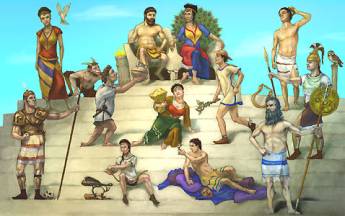
Find out who
the twelve Olympians were.
·
Include at least six illustrations,
one for each "hot spot"
You may want to
include illustrations of: *the god or goddess
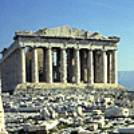
*Greece landscapes or buildings
*symbols or
statues
*famous works of art depicting mythological
figures
You can find this information
through these links
- Be sure
to include the dangers of the areas
Remember
that many myths included dangerous monsters! Be sure to:
*describe
the monster or creature a tourist may come into contact with
*mention
special powers and weaknesses
*advise
your visitors how to avoid contact with the creatures
*possibly
advise your visitors what to do if they have a run-in with the monster!
- Some
pointers for organization
*Put
all information pertaining to one site in the same place – this will make it
easier to read
*First
describe the location – what is this fantastic place?
*Second
describe the god or goddess who rules it
*Warn
tourists of possible dangers (don't get dramatic! You don't want to scare your
tourist away!)
*SELL!
SELL! SELL! You WANT your tourists to visit! Make the location sound exciting,
appealing, and too good to resist! Persuasion is key!
Rubric and Assessment:
|
|
|
|
|
|
|
|
|
|
|
|
|
Making A Brochure : Visiting Ancient Greece |
||||
|
|
|
|
|
|
|
|
|
|
|
|
|
|
|
|
|
|
|
Teacher Name: Ms. Smith |
|
|
|
|
|
|
|
|
|
|
|
|
|
|
|
|
|
Student Name:
________________________________________ |
|
|||
|
|
|
|
|
|
|
CATEGORY |
4 |
3 |
2 |
1 |
|
Attractiveness & Organization |
The brochure has exceptionally attractive formatting and
well-organized information. |
The brochure has attractive formatting and well-organized
information. |
The brochure has well-organized information. |
The brochure's formatting and organization of material are
confusing to the reader. |
|
Writing - Grammar |
There are no grammatical mistakes in the brochure. |
There are no grammatical mistakes in the brochure after
feedback from an adult. |
There are 1-2 grammatical mistakes in the brochure even
after feedback from an adult. |
There are several grammatical mistakes in the brochure
even after feedback from an adult. |
|
Graphics/Pictures |
Graphics go well with the text and there is a good mix of
text and graphics. |
Graphics go well with the text, but there are so many that
they distract from the text. |
Graphics go well with the text, but there are too few and
the brochure seems "text-heavy". |
Graphics do not go with the accompanying text or appear to
be randomly chosen. |
|
Content - Accuracy |
All facts in the brochure are accurate. |
99-90% of the facts in the brochure are accurate. |
89-80% of the facts in the brochure are accurate. |
Fewer than 80% of the facts in the brochure are accurate. |
|
Knowledge Gained |
All students in the group can accurately answer all
questions related to facts in the brochure and to technical processes used to
create the brochure. |
All students in the group can accurately answer most
questions related to facts in the brochure and to technical processes used to
create the brochure. |
Most students in the group can accurately answer most
questions related to facts in the brochure and to technical processes used to
create the brochure. |
Several students in the group appear to have little
knowledge about the facts or technical processes used in the brochure. |
|
|
|
|
|
|
|
|
|
|
||