Brian Robinson
LS 521- Spring ‘02
4/14/2002
How Could Human Beings Do This?
A WebQuest for
7th or 8th Grade Social Studies
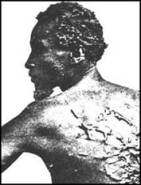
When the Civil War
finally ended in 1865, there were approximately 4 million slaves in America. These were African-Americans either born
into slavery or brought over from Africa.
Human beings were being forced to work for free in the most terrible of
circumstances. Imagine if you had to
wake up at dawn everyday, work until dusk, the whole time getting no breaks,
and little or no food. If you tried to
escape and were caught, you would be severely beaten and maybe even
killed. This was your life and there
was no way out. Slavery was a way of
life and a reality in the United States until the Civil War brought the
emancipation (freedom) of all slaves.
From a moral (right vs. wrong) standpoint it was a victory for
humankind, however, from an economic and social view, it was a disaster for the
Southern states. Regardless of whether
slavery was moral, it was a way of life for the plantation owners and farmers
in some Western states and the South.
They had spent large amounts of money on their slaves and to lose all of
that investment and their workforce was a devastating blow. Not only that, but the plantations and power
of slave owning was a social way of life that would never again occur.
Even though slavery was
abolished over 240 years ago, it is important to understand, because the
effects are still being felt today. Its
importance to American history may never be fully measured.
The Task
You are to immerse yourself in
the times using the resources provided.
Read and absorb as much as you can, because you will be combining that
knowledge with the feelings this information brings to understand the human, as
well as historical, parts of slavery.
You
will:
·
Read
over views and summaries of slavery and its context in American history
·
Read
first hand accounts of the life of a slave
·
Take
notes on the day-to-day activities and environment that filled a slave’s day
(at least ten items)
·
Discuss
your conclusions and thoughts with classmates in small groups
·
Write
a “Letter to the Editor” as if you were a former slave owner whose life was
changed at the end of the Civil War
·
Create
a fictional account of a day in the life of a slave based on your research
·
Choose
a topic for a research project on a related topic
The Process
Part 1: Overview of Slavery
To begin your look into
slavery, you will review the two sites below on slavery and its relationship to
the Civil War. Be sure to think about
each side of the equation; the slaves
and their owners. It is important to
understand the feelings of each party, as the Civil War was fought for
political, social, economic, and emotional reasons. Be sure to take notes on anything you find relating to the
different positions in the slavery issue.
-Read a brief history of slavery at Discovery.com
http://school.discovery.com/schooladventures/slavery/world.html
-This piece describes the causes of the Civil War in a
brief and “balanced”
way.
http://americanhistory.about.com/gi/dynamic/offsite.htm?site=http%3A%2F%2Fwww.members.tripod.com%2F%7Egreatamericanhistory%2Fgr02013.htm
Many views of slavery were
biased dependent upon the author’s feelings and the side that he took, of either
a slave or an owner. This account is
from a British journalist and is very interesting. Notice that he does not take a side, even though he most likely
wanted to.
Life of Plantation
Field Hands, 1857
http://www.fordham.edu/halsall/mod/1857stirling.html
Part 2: The Slaves
Below are accounts of former
slaves collected in the 1930’s by the Federal Writers’ Project
of 1936-1938. You will choose at least
three to read, although they are all interesting. Be sure to take detailed notes regarding aspects of the daily
life and the trauma that each slave had to endure day in and day out.
-Read about Alice
Lewis- “ My white folks was good to their [slaves]”
http://memory.loc.gov/cgi-bin/ampage?collId=mesn&fileName=080/mesn080.db&recNum=48&itemLink=D?mesnbib:1:./temp/~ammem_qJtK::
-Read about James
Calhart James- “They realized their father was my father… they hated me”
http://memory.loc.gov/cgi-bin/ampage?collId=mesn&fileName=080/mesn080.db&recNum=36&itemLink=D?mesnbib:8:./temp/~ammem_qJtK::
-Read about M.S.
Faman- “I was separated from the other children [and] taken bodily by a
white man”
http://memory.loc.gov/cgi-bin/ampage?collId=mesn&fileName=080/mesn080.db&recNum=12&itemLink=D?mesnbib:14:./temp/~ammem_qJtK::
-Read about Rev.
Silas Jackson- “My master was named Tom Ashbie, and a meaner man was
never born”
http://memory.loc.gov/cgi-bin/ampage?collId=mesn&fileName=080/mesn080.db&recNum=32&itemLink=D?mesnbib:19:./temp/~ammem_qJtK::
-Read about Solomon
Northup- “His approach to the gin- house is always with fear and
trembling”
http://vi.uh.edu/pages/mintz/10.htm
Part 3: The Debate
From groups
of four, break into pairs. Each pair is
to take a side in the debate. With your
partner, review the notes and talk about some specifics points that you have to
support your side of the story. When
you have finished, come back together.
In your small groups of four discuss what each pair came up with. This is not a fight, it is simply a
discussion and a sharing of ideas. If
you begin to get agitated, call for a timeout and come see the teacher. These issues are very emotional, and can
lead to heated exchanges. Remember, a
war was fought over this!
Part 4: What You Will Do (before completing the assignments, please
skip below to “Learning Advice”)
1.
Write
a “Letter to the Editor” posing as a slave owner in Maryland who has lost
his/her slaves and plantation due to the Civil War and the Emancipation
Proclamation.
2.
Create
a fictional account of a slave boy or girl who must go out in the fields to
work. Include as many details as you
can.
3.
Choose
a topic for a research project that will be completed over the next several
weeks. It must be related to something
that you saw in this activity. You will
need to have three reasons why the teacher should give you the “OK” for this
topic.
Learning Advice
The
purpose of this activity is to transport yourself and your thinking back in
time. It is important to develop your
ideas as much as possible. Support your
claims (in the letter) and your fictional account with actual facts from your
research. Be respectful of your
classmates and their feelings in both the discussion and your writing, but do
not be afraid to dig deep into this topic.
This subject is frightening, but of crucial importance, as slavery is
still being discussed today. You will
be graded on both your effort and your honesty. If you feel strongly about something, say so, and support those
thoughts. As you are working through
this material, be sure to consult with the rubric below.
Rubric
|
|
Excellent |
Satisfactory |
Needs
Improvement |
|
Letter |
Well written with passion and flair that mirrors the
times. Original and supported thoughts. |
On target with issues and supports thoughts. |
Lacks focus, little or no support or original thought. |
|
Fictional Account |
Takes creativity to a new level. Demonstrates
understanding of both historical and emotional aspects. |
Original ideas that are supported by facts. |
Off target account with little or no relevance to
researched testimonials. |
|
Discussion |
Active leader in discussion, unafraid to broach
difficult topics. |
Contributions show respect for others and the topic. |
Inconsiderate and undeveloped thoughts. |
|
Overall Organization |
Well organized with extra effort in the details and
integration of content. |
Organized with logical supports for ideas. |
Poorly organized with little or no attention to detail. |
|
Overall Grammar and Spelling |
No errors and smooth word flow. |
Little or no errors. Appropriate word usage and
choices. |
Many errors and inappropriate word usages. |
Conclusion
Slavery is an issue that
underlies many aspects of today’s society.
Socio-economic conditions that began at the end of the Civil War are
still present today in some parts of the South. The Civil Right’s movement and many laws and regulations that
affect us today are results of slavery and the Civil War. In terms of our nation, the Civil War was
the only time that so many Americans fought against other Americans and wet the
soil of our nation with their blood.
Given the number of topics that have been hotly contested in our history
(Prohibition, Isolationism, Vietnam, and others), the fact that only one became
a war means that it must have been and is a topic of monumental
consequence. In fact, there is current legislation
regarding possible reparations (payments) to descendants of slavery. Therefore, an understanding of slavery and
its issues would be beneficial as we try to come to a conclusion on this subject
that is still here, 147 years after every slave was freed.
Interesting Follow-Up Information in
Reparations Debate:
PLEASE BE AWARE THAT THIS ISSUE BRINGS OUT CONTROVERSIAL
AND VICIOUS DEBATE, THEREFORE THE FOLLOWING LINKS ARE SIMLPY FOR PERSPECTIVE
AND YOUR INFORMATION. THEY DO NOT NECESSARILY
REPRESENT THE VIEWS OF YOUR TEACHER.
http://news.mpr.org/features/200011/13_williamsb_reparations/
10 Reasons Why
Reparations is a Bad Idea For Blacks-
And Racist Too
http://www.freerepublic.com/forum/a3a54b37c6b16.htm
IRS
Urges African-Americans to Beware of Tax Refund Scams
http://www.taxes.com/slavery_reparations.htm
Sources and References
Born
in Slavery- Library of Congress website that has over 2,000 slave accounts by
those who lived through it.
http://memory.loc.gov/ammem/snhtml/snhome.html
Civil War Menu-
Part of the History section of About.com,
this site offers many resources regarding the Civil War.
http://americanhistory.about.com/cs/civilwarmenu/
Google.com- Search
results using this site were numerous.
Use “Civil War”, “slavery”, and other key words to find hundreds of
sites, links, and essays.
http://www.google.com
Understanding
Slavery- Part of DicoverySchool.com,
this site includes information about the slave trade on three continents, slave
auctions, and other historical accounts regarding slavery.
http://school.discovery.com/schooladventures/slavery/index.html
Claims for Reparations
Head to Court- Information regarding the possible reparation payments to
blacks for the slavery of their ancestors.
http://law.about.com/library/weekly/aa010501a.htm