Jacquelyn C. Olson
June 28, 2009
SLM 521 – Olson - Dropin 5
5th Grade Science
How Do Clouds Form?
|
Introduction: As we continue our lesson on cloud
formation, we will be looking at a video from the NASA website, reading an
online article and talking about the different types of cloud formations
resulting from this cycle. |
|
Objectives: |
|
|
Upon completion of this
lesson, the student will be able to: |
|
|
1. |
Explain what cloud
formation means and how cloud formation is accomplished. |
|
2. |
Define the terms: evaporation, condensation, precipitation
and collection. |
|
3. |
Explain the steps in the
water cycle. |
|
Activities: |
|
|
1. |
Click on the picture below to
follow the link to the NASA website.
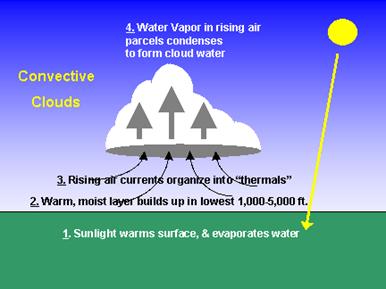
Select and watch the video clip entitled “Our World: Cloud Formation.” http://www.nasa.gov/audience/foreducators/nasaeclips/ourworld/earth.html |
|
2. |
Take notes on the
information in the video. This
information will be necessary to complete other activities in this lesson. |
|
http://www.nasa.gov/audience/foreducators/nasaeclips/ourworld/earth.html |
|
2. |
Read the following article
entitled “The Water
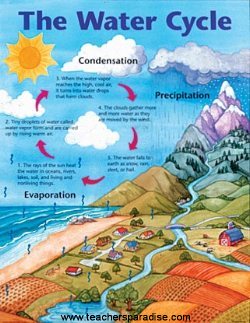
Cycle” http://ga.water.usgs.gov/edu/watercyclehi.html Follow the links throughout
this article to learn more about how each part of the water cycle works. Remember:
the information in this article will help you to complete other
activities remaining in this lesson.
Take notes. |
|
|
|
3. |
Complete the following
worksheet on the water cycle. We will
then break up into small groups of 3 to 4 students to discuss our answers. |
|
Name__________________________________ |
Date___________________________________ |
|
Class___________________________________ |
|
|
1. |
What is evaporation and how
does it relate to condensation? |
|
2. |
Explain what scientists
mean by condensation. |
|
3. |
What occurs when the air
cannot hold all the condensed water?
What forms can it take? |
|
4. |
The last part of the cycle
is collection. Explain what happens
during this part of the cycle. |
|
5. |
After the entire cycle is
complete, what happens? |
|
6. |
When we say that ice and
snow can sublimate, what does sublimate mean?
Explain your answer and use examples from the article. |
|
7. |
Without the addition of what,
ice could not sublimate into vapor? |
|
8. |
How do we know that the
atmosphere is full of water? What is
evidence of this? |
|
9. |
What is surface runoff? |
|
10. |
Where does most surface
water flow to? What process makes that
possible? |
|
11. |
Where does this cycle
end? Explain. |
|
|
|
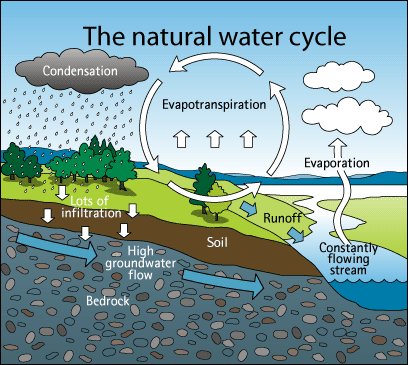
Auckland City Government Image http://www.aucklandcity.govt.nz/council/services/stormwater/images/naturalcycle.gif |
|
4. |
Now test how well you
understood all the material in this lesson by taking the water cycle quiz
by following the link. To check your answers, select the button at the bottom
of the page.
http://education.jlab.org/reading/water_cycle.html |