Jacquelyn C. Olson
SLM 521 - Dropin
#4
Fourth Grade Science Lesson
June 25, 2009
|
Fossils: What
are They and Where are They Found? |
|
|
|
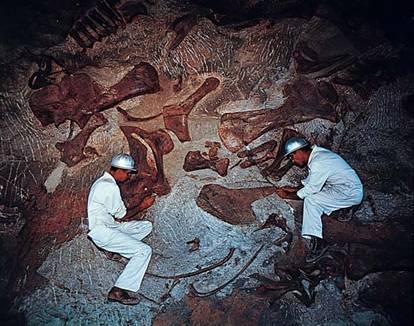
Scientists excavating dinosaur fossils from a quarry wall in Dinosaur National Monument, Colorado. National Park Service |
|
Students will discover the
basic characteristics of fossils, how paleontologists locate them, and how
museums classify and maintain them. |
|
Objectives: |
|
|
Upon completion of this
lesson the student should be able to: |
|
|
1. |
Define the terms fossil,
paleontologist, and excavate. |
|
2. |
Discuss the different types
of fossils, where they are most likely to found and approximately when they
were created. |
|
3. |
Compare and contrast the
differences in the types of fossils in the different eras of history. |
|
4. |
Create a virtual
representation of a dinosaur dig. |
|
Did you ever wonder how
museums obtain dinosaur remains and fossils?
To begin today’s lesson, we will read an article written by Alfred
Fisher called “Fossil
Record” on the Scholastic Website (http://www2.scholastic.com/browse/article.jsp?id=5007) to learn more about how fossils are formed and
discover where scientists have uncovered dinosaur remains. Click on the link above, and read the
article. Look for the answers to the
following questions and record your answers on a separate piece of paper: |
|
1. |
What types of fossils are
most likely to be found in limestone? What
are large deposits of vertebrates’ bones and teeth called? |
|
2. |
In the world’s “red beds”
found in mostly in sedimentary rocks, what might scientists find? |
|
3. |
What are entire or partial
bodies of organisms called? |
|
4. |
Name several other types of
fossils and describe them. |
|
5. |
Name one of the areas where
the accumulations of sediment reveal bodies of plants and animals that have
retained their general form? Why would
fossils found in these areas be of greatest value to the paleontologist? |
|
6. |
Name two other periods in
history, the types of fossils typical in these eras, and where fossils from
these eras have been found. |
|
7. |
Who was Robert Hooke and
why did he believe that fossils might be a chronological guide to geologic
history? |
|
Our second activity for
today will be a visit to the National Museum of Natural History in the
Smithsonian Institution. We will
discover the top ten misconceptions about dinosaurs and take a virtual museum
tour where you will see pictures of actual fossils,
learn when and where they were found, and how paleontologists take care of
the fossils at the museum. Lastly, we
will all get to participate in our own dinosaur dig. |
|
|
![[Credits : Encyclopædia Britannica, Inc.]](dropin4_files/image004.jpg)
|
First, click on the link to
discover the top
ten misconceptions (http://paleobiology.si.edu/dinosaurs/info/misconceptions/main.html)
about dinosaurs. As you read through
them, I would like you to think about how many items you believed before
participating in these activities. |
|
|
|
The exhibit “Jane: Diary of a Dinosaur,” which opened June 30 at the Burpee Museum in Rockford, Ill., featured a notable well-preserved specimen that the museum identified as a juvenile Tyrannosaurus rex. It stood about 2.3 m (7.5 ft) high at the hips and was about 8.5 m (28 ft) long. |
![The exhibit “Jane: Diary of a Dinosaur,” which opened June 30 at the Burpee Museum in …
[Credits : Photo by M. Graham]](dropin4_files/image006.jpg)
|
Next, follow the link to
the virtual
museum tour (http://paleobiology.si.edu/dinosaurs/info/misconceptions/main.html)
at the National Museum of Natural History.
Follow the prompts to view the information and images included in the
tour. Be sure to complete the entire
tour which includes a visit through the Curator’s office. Does the tour include any of the fossil
remains that you learned about in the “Fossil Record” article which you read
at the beginning of these activities?
If so, which ones? Were you
surprised to see what actual fossils look like in 3D, instead of merely
viewing pictures of them? What
questions would you ask paleontologists at the museum? Please record your answers on the same
paper as the answers to the “Fossil Remains” questions. |
|
|
|
Fossilized footprint of an
unidentified dinosaur. © Getty Images |
![Fossilized footprint of an unidentified dinosaur.
[Credits : © Getty Images]](dropin4_files/image008.jpg)
|
To complete our virtual
dinosaur activities, we will each participate in a virtual
dinosaur dig (http://paleobiology.si.edu/dinosaurs/interactives/dig/dinodig.html)
on the National Museum of Natural History’s website. We will imagine that we are in the year
1891 in Wyoming and we have located a site where dinosaur remains from the
late Jurassic Period have been found.
Please click on the virtual dinosaur dig link above to begin your
fun! As you move through the dig, pay
attention to the prompts. They will
guide you through finding and excavating your fossil. You will learn important information about
the anatomy of your fossil and general information about where the animal or
plant lived and when. You will also
view a short slide show to illustrate what your fossil may have looked like
with skin and muscle tissue. |
|
Now that you have
experienced first-hand what it is like to be a paleontologist, on a separate
piece of paper, I would like you to make a list of five dinosaur facts that
you have learned from this lesson. I
would also like for you to provide me with your reaction to these
activities. What was your favorite
part of the lesson? What other activities would you like to have included as
we studied dinosaurs and fossils?
Lastly, has your perception on fossil remains changed since you began
these activities? In other words,
prior to this lesson did you believe that actual fossils existed or did you
believe fossil stories were tall tales?
Please explain your answer. |