Damon Norko
SLM 521 – February 21, 2006
Weblink Bibliography Assignment
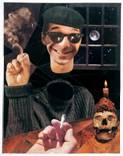 Larry Wessel, Midnight Café
(2001)
Larry Wessel, Midnight Café
(2001)
WEB BIBLIOGRAPHY
The Beat Movement
Few artistic movements have had more impact than the Beats. Virtually every genre -- music, visual art, writing – in the 1950’s and 60’s was affected by the expression and experimentation of these free spirits.
The roots of beat art go back further in time but the seminal works of Jack Kerouac with On the Road (1957), William Burroughs with Naked Lunch (1959) and Allen Ginsberg with Howl (1956) mark the beginnings of the popular movement.
It’s hard to say whether the Beats were inspired by the social revolution of the 1950-60’s or vice-versa, but it’s clear in retrospect that both the social change and the artistic movement occurred at the same time, and thus are intertwined.
What is a beat? What is a beatnik? By researching the individuals and groups on the selected and recommended websites below, you will find the answers to these questions and more ….
(ALL SITES CURRENT as of February 12, 2006!!)
Beat Movement -- General
Sites
There are indeed a zillion sites about the beats. These are four of the more interesting.
Here is a website that has an excellent compilation of the works of the writers and artists of these times. Includes an online gallery and links.
http://www.beatmuseum.org/
A website specializing in links to other site (some are no longer valid). But there are still some fine connections and supporting information such as a gallery and other writings
http://www.rooknet.com/beatpage/links/index.html
A truly comprehensive account of the Beats, with excellent photos. Makes you almost want to quit your job and get in a VW bus and hit the road …
http://www.lucaspickford.com/burrbeats.htm
Another excellent site focusing on the pop culture side of the beat movement. Lots of links, lots of artwork, including the one at the top of this page.
http://www.beatsvillepad.com
Places
Although traveling and the “American Experience” was a great part of the movement, the places below – perhaps due to proximity of Universities (Berkley, Columbia) or simply due to the location of publishers and galleries -- hosted much the artistic fervor of the Beats.
The “second center” of the Beat
scene,
http://homepage.mac.com/thorntonstreiff/Menu9.html
Grateful Dead, Timothy Leary, Zap
Comix … this was the place, the
http://www.rockument.com/haimg.html
Preceding San Franscisco
by decades in bohemianism, Greenwich Village in
http://en.wikipedia.org/wiki/Greenwich_Village
Individuals
While not a comprehensive list of the people involved, this group of influential beats is a nice summary of the people and ideas which fueled the movement. It is interesting how their stories are intermingled. I omitted people who, while famous, did not contribute a great body of work (Neil Cassady) or who insisted on distancing themselves from the movement (Richard Brautigan). Many other links are available on the sites mentioned above, but I found these below to be “value added” for the student of these times.
William Burroughs
This is a good site summarizing the works of the “elder statesman” of the beats. Fully a decade older than most of his friends, his life was full of interesting hi-jinks. (I shook hands with Burroughs at his 77th Birthday party, thinking “Where has this hand been?” A good biography plus excerpts from his fiction. Highly recommended!
http://www.thei.aust.com/bill/burroughs.html
Here is a catalog of Burroughs’
personal effects, compiled and stored at the
Allen Ginsberg
Allen Ginsberg -- Shadow Changes into Bone
Fan pages don’t get better than this compilation of photos, writings by and about Ginsberg, and event notices (such as the 50th anniversary celebration of Howl).
http://www.ginzy.com/
Jack Kerouac
Here is a fine webpage dedicated to Kerouac. Besides a nice bio there is an excellent summary of books about him and further research materials.
http://www.tijean.freeserve.co.uk/
Billed as “the most famous
bookstore in the world”, this avant-garde bookstore (and publishing house) was
founded in
http://www.citylights.com/
An excellent and fairly recent (2001) interview with Ferlinghetti
http://www.sanfranciscoreader.com/interviews
/ferlinghetti%20interview.html
Charles Plymell
From Kansa, Land of the Wind People
Plymell
and his wife roomed with Ginsberg and in the 60s and moved to
http://home.nycap.rr.com/charlesplymell/GALE.htm
Charles Plymell Cosmic Baseball
More on one of the more influential-yet-peripheral figures in the beat movement. Among his many accomplishments, he was the first publisher of BEAT COMIX, the prototype for all underground comics!
http://www.cosmicbaseball.com/plymell0.html
Herbert Huncke
This is an article reviewing Huncke’s autobiography by Harvey Pekar. Good summary of his life, the man who was the inspiration for Burrough’s Junkie.
http://www.metroactive.com/papers/metro/12.04.97/books-9749.html
Charles Bukowski
A great stylist who beat to his own drum, Bukowski’s work seems to grow in stature instead of fading away. This site has it all … bio, bibliography and even his FBI file!
http://bukowski.net/
Gary Snyder Poet
Gary Snyder was a
http://www.heureka.clara.net/art/snyder.htm
Ken Kesey
Ken Kesey & The Merry Pranksters
A short biography and brief reviews of his major works, including the famous “One Flew over the Cuckoo’s Nest.”
http://www.lib.virginia.edu/small/exhibits/sixties/kesey.html
This site has pictures, poems, and a moving obituary of Kesey.
http://www.intrepidtrips.com/kesey/index.html
R. Crumb Keep on Truckin’
This is a very small site with showing the original 1967 cartoon. You have to see this to know who Crumb is. Remember, Charles Plymell, above, was the first publisher of Crumb’s work.
http://www.crumbmuseum.com/truckin.html
A fan site, full of wonderful examples of Crumb’s art.
http://www.crumbmuseum.com/crumb1.html
As Crumb is still a marketable commodity, many sites including his own are selling his work rather than telling his story. The best summary I found is on Wikipedia. Also note Crumb has a major documentary on him by Sony Pictures. Links to the trailers are provided.
http://en.wikipedia.org/wiki/Robert_Crumb
Michael McClure
Still active, Michael McClure’s homepage contains links to most of his work and articles about him. A Beat Poet who reinvented himself for later generations, he has been read by “Hell’s Angels and Nuclear Scientists.”
http://www.thing.net/~grist/l&d/mcclure/mcclure.htm
Last Word
I do hope you enjoy these sites as much as I enjoyed putting the list together. For me, it is a bit of a trip down memory lane. As a very young man who styled himself a poet/writer in the Beat tradition, I sought out and met several of these people. Charles Plymell I consider a great friend and through him I was able to meet Burroughs, Huncke and Ginsberg.
I wish I had done this kind of research back then, as I found myself tongue-tied and staring at my sneakers for the most part, not knowing much about them except that they were famous Beats..
I did manage to interview Huncke for a magazine. This interview was cut short when he had to go downstairs to the basement to shoot up. “Want to come – there’s nothing to be afraid of,” I remember him saying.
But I, indeed, was afraid.