Patricia Jimenez
SLM521
Politics in Music
 During the
Great Depression artists like Woodie Guthrie sang songs in protest of social
conditions. He was not the first,
During the
Great Depression artists like Woodie Guthrie sang songs in protest of social
conditions. He was not the first,
nor the last. Though few mainstream artists infuse politics
into their music, some use the media as a soundboard in the struggle for human
rights and democratic freedoms.
Directions: Visit the
following websites. Scan for connections between music and politics. Consider how this entertainment media has
affected the roles of citizenship and democracy. This two-session activity will provide you
with a background and preparation for class discussions on the meanings and
functions of lyrics. As you listen to
the clips, rate the music by completing the opinion table.
Music and Politics – Start by reading this article from Wikpedia Encyclopedia about the connection between music and politics. Although we will concentrate on popular music of today, learn how musicians use(d) music to express protest.
Beethoven, Verdi – and someone you don’t know – Jay Nordlinger, editor of National Review Online, wrote this article in September, 2003. It references several great musicians throughout history and how their ideologies fused with their music.
Stop,
Hey, What’s That Sound – Visit the

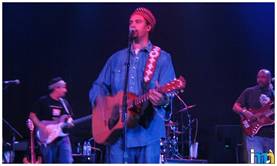

Bono of U2 Franti of Spearhead Madonna
Politics
and Franti – “I was angry because I was
powerless,” he says. This article
demonstrates Franti’s belief that attitudes and history can be affected by
music. He openly uses his music to
profess his Democratic political views.
On Stage:
Faith, Music, and Politics – A video article posted through Washington
Post.com. This video refers to the
seeking of Republican votes through Christian Rock music and concerts.
Rapper Jadakiss
– Does his controversial song “Why” seek mainstream attention or commercial
recognition? You decide.
Other Opinions and References to scan:
The
Musician’s Role – This opinion article was first published on CLUAS in
October, 2004. CLUA is a music magazine
posted on the World Wide Web from
Politics With Soul – This article acknowledges the influence music can have on culture while arguing that music manufacturing is pressured by marketing. “Political music is essentially a mode of activist communication.” Individuals have the choice to take part.
Ain’t That America – This is a music review of the
fifteenth Farm Aid Concert in
Country
Music Lyrics – This article entitled, “A world without citizenship: on
politics and ideology in country music lyrics, 1960-2000,” was published in the July 2005 issue of Popular Music and Society.
It is rather lengthy. Do not read it, but rather scan for an idea of its
content. Please notice the entry on page
5 concerning Tom T. Hall and “Hello,
Lyrics, Listening
Clips, and Ratings:
As you listen to the music clips
complete the opinion table. Be sure to
add your name to your work. Print out
the table and place it in your music folder.
Wackiavelli –
The mission statement of this R&B band states their intentions of
delivering their political views. Music
is their “weapon of choice.” There are
four clips to choose from. To listen to
“Mislead the People,” click
here.
Bruce
Springsteen – originally wrote the Mainstream Rock song “My City of Ruins”
for
Bob Dylan – Known for
such folk-rock songs as “Blowin’ in the Wind,” The Times They Are a Changin’,” and
“Chimes of Freedom.”
Toby Keith – the
angry American who kicked people to attention with “Courtesy of the Red, White,
and Blue” after 9/11. Be sure to read
the last paragraph of the bio. Click here to get to
the video page, choose “Courtesy of the Red, White, and Blue.”
Ray Stevens – His keen wit and
spoof has been true entertainment for four decades. Click on this political
view video, “Osama Yo’ Mama.”
System of a Down – Tankian, lead
singer, states, “Our music has always been urgent, critical and questioning.” This Heavy Metal group of Armenian Americans
intends for its messages to be socially viable.
View the lyrics to “War.” [Click on Words/Lyrics. Choose System of a Down album title. Click on War.] Although you will hear clips
of their music, you will not be able to select a particular one for listening.
Opinion Table:
Rate the effect of each composition by marking 1, 2, 3, 4,
or 5 in each category.
1 = strongly
dissatisfied
2 = dissatisfied
3 =
neutral
4 = satisfied
5 = strongly
satisfied
|
Musician and Composition |
Quality of the
Music |
Educational to
the listener |
Effectiveness
of message (encourages
action) |
Effective
marketing strategy |
Would you buy
this CD |
|
Wackiavelli Mislead
the People |
|
|
|
|
|
|
Springsteen My
City of |
|
|
|
|
|
|
Bob Dylan Chimes
of Freedom |
|
|
|
|
|
|
Toby Keith Courtesy… |
|
|
|
|
|
|
Ray Stevens Osama
Yo’ Mama |
|
|
|
|
|
|
System of a Down War |
|
|
|
|
|
Select the opinion table.
Print out your work and
place it in your music folder.

Activity for extra
credit:
Open a Word document and write an
essay on the connections of music and politics.
Consider your reactions to the following questions in your responses.
- Do
you choose to listen to your favorite songs because of style, content, or
fandom?
- Is
there more power in music than mere words?
How?
- Does
rhythm and genre of music affect the message of the lyrics?
- Have
your ideals, values, or ideologies been affected by your choice of
music? Offer an example.
- Should
pop artists just entertain and not try to persuade audiences on political
issues? Why or why not?
- Has
recording history and world wide tours allowed musicians to take a more
active role in politics? Justify your answer.
- Does
the power of music come from the words or do the words gain more power
through the music? Try to cite an
example to support your response.
- Should
music be censored -or lyrics altered- by the media, government, parents,
or any other source? Validate your
opinion with circumstances, music examples, and coherent reasoning.
- List
a few popular songs and their artists which seek to motivate political
educational or action.
“He who pays the piper
calls the tune.”
