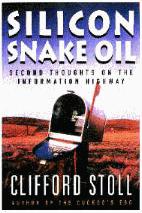
 Silicon
Snake Oil - Second Thoughts on the Information Highway
Silicon
Snake Oil - Second Thoughts on the Information Highway Crossley, Karen
LS521MC Sum02
July 14, 2002
Silicon
Snake Oil - Second Thoughts on the Information Highway
"When Stoll writes that the Internet is not the technological promised land that so many computer whizzes think it is, it seems wise to pay attention." Chicago Tribune
Book Information:
Silicon Snake Oil
by Clifford Stoll
Doubleday
New York: Doubleday
$29.95 cloth
Clifford Stoll has written a book, Silicon Snake Oil, which brings up many concerns about the limitations and dangers of using the Internet. I'll name five of his concerns below, along with my own ideas about how these concerns can be addressed or ameliorated. Quotes from Stoll are in quotation marks.

1. The important interactions in life occur between people, not computers. "computer networks isolate us from one another, rather than bring us together."
I agree that personal interaction is essential for all people, especially for children just learning social skills. However, any competent teacher will use the Internet in an interactive way, such as a WebQuest where groups of children work together. People who allow themselves to become socially isolated were probably loners before the computer came along, and most of those "computer nerds" have been able to find a community of like-minded enthusiasts online.
Many people use the Internet to build
supportive relationships. Young people are especially adept at using
technology to broaden their experiences and enrich their social fabric.
Another trend is that the elderly are using the
Internet to locate "support groups, learning centers, volunteer services,
and travel information." Many elderly people log on to avoid the loneliness
that often comes when a physical disability hinders their ability to travel. The
Internet is the only way for these individuals to correspond with family and
friends.
2. "Simply by turning to a computer when confronted with a problem, you limit your ability to recognize other solutions. When the only tool you know is a hammer, everything looks like a nail."
I think schools and teachers have a responsibility to be sure students use the Internet as only one tool for learning and accessing information. The merits of the library, books, experts, hands-on experiences and cooperative learning need to be demonstrated and used on a regular basis. When the computer's possibilities are explored, it's limitations will also become apparent. Teaching students critical Internet survival skills, such as how to evaluate websites and recognize the source of information, will be essential to help students stay safely on the "information highway."

3. Direct interactive learning experiences are more meaningful than kids using computers in classrooms. "According to the Victoria-Times-Colonist, one consultant suggests that children in their Bayside Middle School "can learn about preserving our island's rain forests by linking electronically with a class in Louisiana studying wetlands. Each learns from the other's land-use issues. That is technology happening now." Why not just rent a bus and drive everyone to Clayoquot Sound, over by the edge of the rain forest, to count banana slugs and thousand-year-old cedars? Or invite foresters and ecologists to the classroom to speak about their problems or worries? Reading text on a computer screen is far less memorable than any of these things."
Online field trips can take students to places they will probably never be able to go - across the country, to foreign lands, into the past, and even into places people are not allowed to go. Of course students still need plenty of hand-on and direct experiences, but again, a good teacher will be sure to encourage learning in a myriad of ways.

4. Online information sources threaten support for and use of traditional libraries. Stoll does not think that the internet renders traditional libraries obsolete, but worries that policy-makers might think they do, and that "computers will deviously chew away at libraries from the inside. They'll eat up book budgets and require librarians that are more comfortable with computers than children and scholars. Libraries will become adept at supplying the public with fast, low-quality information."
I've just started my studies to become a school library media specialist, but I can already see that books and library references are considered invaluable resources which are irreplaceable. Librarians will have to be advocates to be sure funds are kept for all resources. I do agree that librarians must be adept at using computers, but people skills will always be essential as well. Another skill that media specialists must focus on is literature and book promotion. Once children learn to love books, they will be lifelong learners, but adults must help them get to that wonderful place. The Internet can be immediately rewarding and visually exciting; books and reading feed the imagination but require more skill to reap the rewards.
5. The Internet is seen by some as a panacea for everything. "Today's Internet hustlers invade our communities with computers, not concrete. By pushing the Internet as a universal panacea, they offer a tempting escape from all this-too-mundane world. They tell us that we need not get along with our neighbors--heck, we needn't even interact with them. Won't need to travel to a library either; those books will come right to my desk. Interactive multimedia will solve classroom problems. Fat pay checks and lifelong employment await all those who master computers."
What I have seen in some teachers and schools is a reluctance to embrace technology, not an overuse of the same. I think as we become more facile in the use of Internet and technology, we will easily see it's limitations. Educators have a responsibility to learn as much as possible about educational use of the Internet - including learning from our students!

Here are some websites to tell you more about Clifford Stoll's view, along with some of his critics.
Chapter Excerpts -
http://www.macatawa.org/~jesiek/snakeoil.html (excerpts)
Book
Listing @ Amazon (with 31 sample pages)
Reviews:
Book Review by
Rory McGreal - http://www.ibiblio.org/cmc/mag/1995/sep/mcgreal.html
Book
Review by - Jackie M. Dooley, Head of Special Collections and University
Archives Main Library, Univ. of California, Irvine,
http://palimpsest.stanford.edu/byform/mailing-lists/exlibris/1995/04/msg00137.html
Teacher Essays in Response to Stoll:
Reflections
on Silicon - Essays by several technology teacher on the issues raised by
the Stoll Article. - http://ed.tsud.edu/tcubed/reflections/reflect_silicon_snake_oil.htm

Return to Karen Crossley's Index Page