Brandy
Burns
SLM521
Drop In #3
Calculating
Body Mass Index
Calculating Your Body Mass Index
(BMI)
BMI is a
good way to interpret your overall health.
It is important to have the ability to have a baseline on which you can
judge your health on your own, without having to go to a doctor or a
trainer. Learning how to calculate your
own BMI and understanding it's importance is a key
element of taking control of your personal well-being. Using the internet and other tools, we will
learn:
What
is BMI?
How
does one calculate BMI?
Interpret
a chart using your BMI.
Discuss
and evaluate the results as a class.
Follow the
directions and record your answers on the worksheet provided.
1. Learn about your BMI by clicking here. You will find a brief explanation of
BMI. Define BMI on your worksheet.
2. Work with a partner to compute both
of your BMI's.
BMI is calculated using this formula.
Please use the standard form, in inches.
Calculate your BMI.
Please
use the measuring tapes provided and use your last known weight. If you are unsure or want more accuracy, I
have a scale you may use.
Record
both of your BMI's on the worksheet.
3. Now that you have a value of your BMI, let's interpret it from the chart
using percentiles:
(Remember to use
the appropriate chart, BOY or GIRL)
4. In what percentile do you
fall? Record in #4.
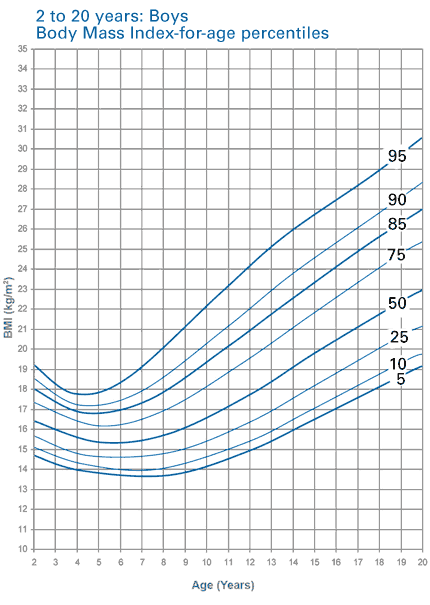
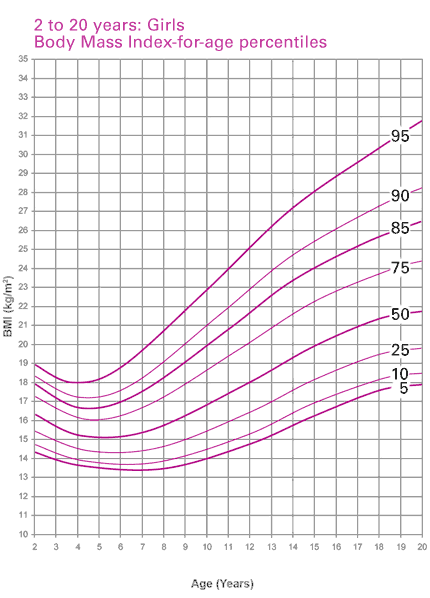
(both from
www.texasheartinstitute.org)
1. Online, there are many different
tools available for computing BMI. We
can also use a BMI calculator. Remember, this calculator is for teens, so it
does not apply to people over the age of 20.
2. Were your numbers similar using the
calculator online? What can you
attribute to any differences? Why do you
think such tools as these calculators are available online?
3. Now we are going to learn why it is
important to use the appropriate charts and formulas for our age group. Please click
here and scroll down to the part "What is BMI"
Read the whole
page, taking notice to the charts especially.
Discuss
with your partner the benefits of using BMI versus other methods.
Record
TWO of these reasons in #7a and 7b.
Discuss
with your partner the reasons why BMI charts are different for teens and
adults.
List
1 reason on your worksheet. Record your
answer in the #7c.
Under
the subtitle "What is a BMI Percentile," record the category in which you fall
in the #7d blank.
Great Work!
Now for tomorrow's class, bring in some ideas that could
help a teen get into a healthier BMI percentile, as well as those behaviors
that would make a teen less healthy.
Please feel free to use the sites we looked at today for
suggestions. If you use another site,
bring it in so that we may all use it if necessary! We
will be discussing your ideas in class as long as the answers to the questions
today.