Web dropin #5
Ratio, Proportion and the Human Body
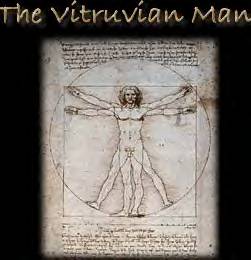
copied from
http://partner.galileo.org/tips/davinci/vitruvian.html
Introduction
|
Vitruvius
was a moderately successful architect and engineer living during the Roman
Empire. His derivation of human proportions was the only theory of proportion
to survive from antiquity. Leonardo (da Vinci) drew from Vitruvius' theory
and corrected his inconsistencies and created a new image. Leonardo's version
of the Vitruvian Man remains to this day the most famous and accurate
depiction of the human body. |
|
copied
from (http://partner.galileo.org/tips/davinci/vitruvian.html) Artists
depict accurate drawings of the human body using proportions and ratios. It was quite surprising to me when we were
assigned an art project in the eighth grade of drawing a face, to find out
that the eyes are actually centered on the face vertically ( the ears are
centered on the eyes, etc.) Drawing
the face without this framework makes the drawing awkward and
unattractive. It
is also interesting to note that throughout the human population what we find
attractive in a face is universal.
The most attractive faces are the ones with the best symmetry. Here is a link to one site explaining an
experiment to determine attractiveness.
http://psych.unn.ac.uk/users/nick/EPppws06/tsld005.htm You
may have failed to realize how math is involved with your attraction to the
opposite sex. You may even want to
compliment someone with – “my you have nice facial symmetry”. |
Information
|
Visit
the following sites giving background on the Vitruvian Man and DaVinci’s
drawings. |
|
|
|
|
|
|
|
|
Activity
|
Using a tailor’s tape measure take five different measurements on your body that were used to inspire da Vinci’s drawing. Set up a chart illustrating the ratio’s. Demonstrate that your body’s ratios are similar to the Vitruvian Man’s body ratios. |