Cynthia Vaskis
SLM521 Spring 2004
Dropin #4 Assignment
File: dropin4.htm
Should the
Today, the Space Program is
at a critical junction. Many people are
unsure as to whether it should continue as planned or if certain programs
should be cut or eliminated. President
Bush’s plan for the program has been questioned by even experts in the
scientific field. On the other hand,
many advancements in the Mars Program with the unmanned rovers, Spirit and
Opportunity, who are gathering valuable data on the Martian surface right now
have inspired many people to support the Space Program. This
drop-in activity is for the students to look at some of the information and
reports on the Space Program and form an opinion of their own. Since there are a lot of Web sites to look
at, the teacher may want to let each student pick a different one and summarize
their findings. That way the overall
effect of the assignment will be that the class as a whole will form an opinion
but from many sources.
There are two major topics
listed below. The first perspective
discusses whether or not we should continue space exploration with manned or
unmanned vehicles since many people have been saddened by the Space Shuttle
accidents. The second perspective covers
whether we should continue the Space Program as laid out for the year 2005 and
as stated by President Bush. There are
some reports on the Web by people who oppose this plan. Many people think that the government should
allow more of the commercial world to become involved in the Space
Program. That way much of the research
could be owned by industry and paid for by them instead of by the taxpayers. The student should decide if the concerns of
those worried about the direction of the program are valid especially whether
or not we should take the military into space.
Many benefits (inventions) have come out of the Space Program and they
are listed below as evidence for continuing the Space Program.
Individual and Small
Group Activity - Discuss the Pros (technology and discovery benefits) versus
the Cons (losses in cost and people) of the Space Program for two perspectives
Search the Web sites listed
for each controversial perspective and briefly
list the Pros (benefits) and the Cons (losses) for each. Depending on how much time is available, the
teacher may want to have the class form two or more smaller groups and assign
only one controversial perspective topic to each small group. Within a small group, each individual could
pick a numbered question to look up on the Web site listed there. Have the individuals in that group go online
to look at the web sites for their selected question and record brief pros and
cons on their assignment sheet. At the
end of the class session (about five to ten minutes left) have individuals
share their findings by reading their Pros and Cons answer sheet to the whole
class.
Then, after every one has
time to share what their group found, take
a vote about each topic, whether the students are for or against each
perspective. Remember, these students
are the voters of tomorrow. Based on the
outcome of the voting process, does the class think that the Space Program will
continue and if so, will there be major changes such as more commercialization
(more companies buying a share in the programs activities) and will the
military be allowed to enter space? Does
the class think that robots will continue to be used to explore space?
Part 1 Introduction
Should the Space Program’s plans for Manned versus Unmanned
(robotic) Space Exploration be supported in 2005 or not?
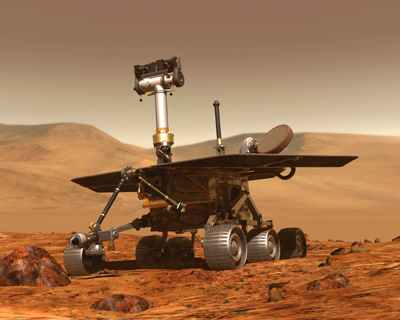
Mars rover (artist’s drawing) (click
on Roverpicture)
Humans can use their
experience to guide them through difficult circumstances and machines have to
be programmed by people who are not interacting with the environment the space
robots find themselves in. All of the
possible maneuvers and environments must be programmed ahead of time into the
robot’s memory and there is no spontaneity during the current situation. On the other hand, the robots have an
excellent memory and can be programmed to remember a lot of scientific data
accurately to guide the experiments. The
robots can also be programmed to ignore certain sensor input data or to pay
attention to sensor data changes no matter how small it is. Also, robots don’t worry and don’t fear
exploring dangerous environments.
Machines don’t give up when given a task as long as its equipment is
working.
Perspective 1 - Should space exploration continue
with just unmanned missions (robots) or should we send people to the Moon, Mars
and beyond?
Robotic explorers, on
unmanned missions, seem to be the best option for initial exploration into
dangerous environments. The Mars rovers
move around the land and view things with a camera. For the rovers to move without bumping into
rocks or getting stuck in a hole, they have to determine what is ahead of
them. The area of Artificial
Intelligence programming called computer vision is able to help analyze the
scene that the camera is viewing and initiate commands to steer it away from
obstacles. The rovers actually have
pairs of cameras to give them binocular vision which, like humans, allow them
to determine distances of objects as they move around.
Robots use math models to control the movement of
their bodies across terrain and of their appendages when performing scientific experiments and while carrying
out maintenance activities. The movement
of their appendages is performed by generating commands that use a coordinate
system and math to calculate the amount of rotation or movement needed to
perform the task. Those math models use the coordinate systems
(Cartesian and Polar) mentioned in Drop-in #1. Math rotation matrices (for X, Y, and Z
axes rotations or angular motion in Polar coordinate directions of up and down,
left and right) mentioned in Drop-in #2 are used to move those appendages and to
rotate their bodies around to point or move in different directions across the
land. Consider the movement of robotic
appendages on the robot such as moving the robotic arms (extending and rotating)
and the hands which pick up, hold, release, or crush objects. The rover’s head has a pair of cameras
mounted forward and a pair of cameras mounted on the rear of the head to permit
binocular vision that can determine distances from objects. There are two cameras mounted in the front
underneath on the body’s chassis to avoid driving over big rocks.
Visit the Mars Web site and
drive a rover around. Notice the
controls and think about which coordinate system is being used to define where
things are on the rover. Think about
which coordinate system is used to control different appendage movements. Click on the web site below to see Mars and
the rovers in action.
Review some of the Web sites below
to answer one or more of these questions.
Use the title either “Pros” or “Cons” for “Manned” or “Unmanned”
missions above your answer so that they can be discussed at the end of the
session. The goal is for you to develop
an opinion about the Perspective topic using your answers to these questions.
1. Discuss the reasons why unmanned missions
(with robots) are better or not than manned (with humans) missions because of
supplies needed for either machines or for people.
2. Discuss what people can do better than
machines and what machines can do better than people.
3. Who or what is better at measuring data for
scientific experiments? Think of
consistency, ability to adapt to environment, duration or ability to collect
data over a long period of time.
4. Who or what allows things to inhibit one’s
performance? Think of human emotions
such as fear and think of mechanical failures on a machine or robot. Can both adjust to such “failures” to
continue and complete their mission?
5. Who is better at reasoning in special
situations (preprogrammed robots or people) and has inspiration to solve
difficult problems? Remember, the robots
can be commanded from Mission Control personnel who can apply their problem
solving skills to the robot commands.
The actual question is when would it be better to have a human there
than a robot? What if we encountered
life or evidence of life?
6. Discuss the problems of
the loss of people and/or equipment due to accidents and, thus, loss of life
and/or the taxpayer’s money. Are the
losses, such as the two Space Shuttle accidents, worth considering stopping the
program?
Use the Web sites below to gather
information to form an opinion about the questions above.
Space Exploration with Robotics Information
Bush’
plans for robotic and human space exploration – Bush’s plan for both
robotic and human deep space exploration.
http://www.opinioneditorials.com/freedomwriters/esq._20040408.html
Mars Quest – Take a tour of the
rovers on Mars and see what they see.
Learn about the mission on Mars happening right now.
http://www.marsquestonline.org/mer/
Educator’ Guide to
Robotics Spacecraft – Robots: Like Us! – Read the author’s view about how
robots and humans are similar and different.
http://www.solarviews.com/eng/edu/robotsc.htm
Mars Exploration
Rover Mission: Multimedia – You can view the images from the cameras on the
two robotic machines on Mars called Rover and
http://marsrovers.jpl.nasa.gov/gallery/images.html
NASA Mars Exploration Real Time Images
Mars Exploration
Rover Mission: Multimedia – You can view the images from the cameras on the
two robotic machines on Mars called Rover and
http://marsrovers.jpl.nasa.gov/gallery/images.html
Future Robotic Military
Bush’s plans for
robots in the military – Read about Bush’s plan for robotic military
personnel in the future.
http://www.atimes.com/atimes/Front_Page/FD10Aa01.html
Actual Martian landscape picture
taken by one of the rovers (click on easthillspicture)

Part 2 Introduction
Should President Bush’s plan for the Space Program be
supported or not supported?
Today, with all of the
interesting space discoveries (a tenth planet that orbits our Sun but way out
there) and exploring Mars with robotic rovers, people are excited about what
will be discovered in the future space exploration missions. President Bush has plans to take the Military
into space to protect us from hostile threats but is this wise considering the
possibility of the weapons being misused?
President Bush also plans on phasing out the aging Space Shuttle program
and building a newer vehicle. The Space
Station program will be complete in 2010 and will it be supported beyond that
time? Bush plans to establish a
settlement on the Moon or beyond (Mars) using both robotics and humans.
All of these plans are being
funded by the United States government and that is really the taxpayers. Should the government seek more support or
funding from the private commercial sector or would this take the control of
the Space Program’s activities out of the government’s hands?
What have been the benefits
from the Space Program in discoveries and inventions? Are people aware of how much the Space
program costs and what percentage of the total Federal Budget is the Space
Program?
The students will look at
NASA’s budget from 2004 and what is the planned budget for 2005. Already more and more commercial companies
are buying space on the Space Shuttle missions and astronauts’ time to perform
experiments. Do you think this is a good
idea or not? What are the legal
ramifications if the experiments are not carried out accurately by the
astronauts and the results are not what the companies expected?
Perspective 2 – The question to each student
will be whether they think President Bush’s Space Program should continue as
planned and whether we should take the
Military into space or not.
Since many math and technology related jobs are also space related jobs
it makes sense to discuss this topic since those high school students
interested in math and science may have a future career in the space
industry. Many types of engineering jobs
utilize secondary level math and physics in the design of space vehicles (the
Space Shuttle, International Space Station, military or commercial
communication satellites. The student is
asked to investigate these Web sites and any others they search for that
discuss the state of the Space Program’s future and to list the Pros and Cons
of continuing the Space Program as planned or not.
Review some of the Web sites below
to answer one or more of these questions.
Answer one or more of these questions and use the title either “Pros” or
“Cons” for “Continue Space Program as Planned?” above your answer so that they
can be discussed at the end of the session.
The goal is for you to develop an opinion about the Perspective topic
using your answers to these questions.
1. List some of the benefits such as discoveries
and inventions that have come from the Space Program (products such as Tang and
bar coding).
2. What are the main concerns that the general
public and Congress (lawmakers) have for Bush’s Space Program and to put the
Military into space?
3. Why is NASA supporting President Bush’s Space
Program? Mention some of the mission
areas they are excited about.
4. The International Space
Station is funded by several governments and but is managed by the United
States. Do you agree with Bush’s plan to
not support the current Space Shuttle program and move on to a newer space
craft? Should the support for the Space
Station after 2010 be discontinued as Bush suggests?
5. Many people site the accidents in the program
as a reason to not continue, such as the two Space Shuttle accidents where all
the astronauts were killed. Do you agree
with continuing the program knowing that more accidents could happen? Do you believe the discoveries and inventions
are worth the risk?
6. The space tourism program earned $20 million
for each mission but has been terminated.
Should we let wealthy civilians buy a trip to space on the Space Shuttle
or to the International Space Station (ISS)?
Use the Web sites below to gather
information to form an opinion about the questions above.
Web sites for NASA and federal government budgets
NASA
begins New Exploration Journey With FY 2005 Budget – Space Program Budget
overview for year 2005.
http://www.nasa.gov/home/hqnews/2004/feb/HQ_04047_FY05_budget.html
Government Budgets – View government budget Web sites.
http://www.omb.gov/budget
Office of
Management and Budget for 2005 – National Aeronautics and Space Administration
– View NASA’s 2005 budget and plans.
http://www.whitehouse.gov/omb/budget/fy2005/nasa.html
Appendix of all government budgets for year 2005 – You can download each individual budget if needed but may take awhile.
http://www.whitehouse.gov/omb/budget/fy2005/appendix.html
Government
budgets for year 2005 – List of individual areas in the government and
their budgets and plans for 2005.
http://www.whitehouse.gov/omb/budget/fy2005/budget.html
Democratic, Republican
Budget Resolutions Treat R&D (Research and Development) Very Differently
– Politics plays a role in Space Program funding.
http://www.spaceref.com/news/viewpr.html?pid=13922
House Science
Committee Democrats Release Their Views and Estimates Report – Democratic
view on Bush’s Space Program plan.
http://www.spaceref.com/news/viewpr.html?pid=13806
Senators
rescue $600M for NASA – Congress gets back lost funding for Space Program.
http://www.al.com/news/huntsvilletimes/index.ssf?/base/news/1079173052160440.xml
Funding
Soars for Technology in U.S. Budget but at What Cost? – View costs of
programs.
http://home.businesswire.com/portal/site/google/index.jsp?ndmViewId=news_view&newsId=20040331005461&newsLang=en
NASA – Missions – Deep
Space (2005 budget overview) – View Space Program budget for year 2005.
http://www.nasa.gov/missions/deepspace/index.html
NASA’s Budget and Planning
Documents – View list of budget web sites for NASA including 2004 to
download file.
http://www.nasa.gov/about/budget/index.htmll
Report
scolds NASA for accounting skills – Some complain of inability to trace
NASA’s expenses and spenditures.

http://www.floridatoday.com/news/space/stories/2004a/spacestoryN0407NASACOSTS.htm
NASA Home page
NASA – National Aeronautics and Space Association
– This is NASA’s (National Aeronautics and Space Administration) home page who
are responsible for the space program including the space shuttle and
International Space Station (ISS). You
can see what is happening with the Space Shuttle, the Space Station, new
technology coming out of the space program, and other NASA projects.
http://www.nasa.gov
Space Program Table of Contents
Space Exploration Table of
Contents – Top level table of contents to NASA programs.
http://www.solarviews.com/eng/toc.htm
History of Space Exploration
History of Space Exploration
– Historical list of space exploration events.
http://www.solarviews.com/eng/history.htm
Space Program Inventions
Try http://www.google.com with “NASA inventions” where these sites came
from list
Try News.Google.Com for more
listings.
Inventions (spinoffs) from
Space - Great site to view inventions that came from the Space Program.
http://spaceplace.jpl.nasa.gov/spinoffs2.htm
About NASA Highlights
– Highlights of NASA’s achievements.
http://www.nasa.gov/about/highlightsindex.html
Inventions – NASA
inventions.
http://www.astronomynv.org
NASA inventions – List of NASA
inventions.
http://icb.nasa.gov/invention.html
NASA Invention of the Year –
Lists the winning NASA inventions of the year mentioned.
http://icb.nasa.gov/invention.html
USDA and NASA Inventions
for June 23, 2000 – SSTI Weekly Digest – List inventions in 2000.
http://www.ssti.org/Digest/Tables/062300t/htm
NASA
Inventions Honored – May 2001 – Lists inventions by 2001.
http://www.photonics.com/spectra/news/XQ/ASP/pbullid.329/QX/read.htm
Nonfiction
books – NASA inventions – Good review of NASA inventions.
http://www.nonfictionreviews.com/cgi-bin/ae.pl?mode=1&article=article1198.art&page=1
President Bush’s plans for the Space Program
Statement of Sean
O’Keefe before Science Senate Cubcommittee – Congressman’s view of Bush’s
plan.
http://www.spaceref.com/news/viewsr.html?pid=12396
Orbital
Wins $60 Million in New Small Vehicle Launch Vehicle Orders From U.S.
Government – Commercial company wins new space vehicle contract.
http://www.orbital.com/Template.php?Section=News&NavMenuID=32&template=PressReleaseDisplay.php&PressReleaseID=392
Web sites for those in support of President Bush’s
plans for the Space Program
NASA
chief defends Bush space plan – NASA supports Bush’s space plans.
http://www.floridatoday.com/news/space/stories/2004a/040204nasa.htm
Congress warms
to a new space plan – Congress supports Bush’s space program.
http://www.upi.com/view.cfm?StoryID=20040330-111655-8797r
NASA
director praises Bush’s space directive – NASA supports Bush in space
program.
http://www.michigandaily.com/vnews/display.v/ART/2004/03/29/40691f9fde3c2
Web sites for the opposition to or worried about
Bush’s plans for the Space Program
Try http://www.google.com or http://news.google.com with “NASA oppose” to
get these sites
Bush’s
Space Plan stalls in Congress – Congress views on Bush’s space plan.
http://www.sunherald.com/mld/sunherald/news/politics/8144651.htm
Rumsfeld Commission Warns
Against “Space Pearl Harbor” – Hesitant views on taking the military into space.
http://www.spacedaily.com/news/bmdo-01b.html
Lawmakers
Express Concerns Over Bush Initiative – Congress’ concerns about Bush’s
space program.
http://www.universetoday.com/am/publish/lawmakers_concerns_bush_initiative.html?1132004
Shooting
Stars – The U.S. Military Takes First Step Towards Weapons in Space –
Putting weapons in space.
http://abcnews.go.com/sections/SciTech/US/space_weapons_040330.html
Dark Matter –
Weapons in Space – The military entering space via new space weapons.
http://www.themoscowtimes.com/stories/2004/04/09/120.html
Aljazeera.Net
– Most Americans oppose Bush space mission – Personal opinion of writer
about Bush’s space program.
http://english.aljazeera.net/NR/exeres/8BBC2871-7640-4CAB-8383-7094F965DC0F.htm
Mars Opposition Sparks
Traffic Hike for NASA site/Martian Soil – Views on Martian exploration.
http://www.martiansoil.com/archives/001089.php
Global
Network – NASA Hires Public Relations Firm to Help Blunt Opposition to Nuclear
Rocket 12/12/03 - NASA is concerned about public view of rockets in space.
http://www.globenet.free-online.co.uk/articles/nasa_prometheus_pr.htm
Stop Cassini: NASA’s Deadly
Plutonium Probe – View on weapons in space.
http://www.animatedsoftware.com/cassini/
Space
Future- SAS and NSS Oppose NASA’s SLI Funding – Opposition to Bush’s space
plan.
http://www.spacefuture.com/lists/sf-discuss/October-2000/msg00000.html
Commercial applications and the Space Program
Space Agency
Wants to Boost Missions on ISS to One Year (mentions space tourism program)
– Views to extend Space Station missions to one year.
http://www.themoscowtimes.com/stories/2004/03/29/013.html
Spaced
Out on the Interplanetary Internet – The Internet is across the universe,
communicating with Mars.
http://www.thefeature.com/article?articleid=100521&ref=824328
Air
Force pursuing secret program to protect airliners – Air Force wants to
install device on commercial airlines to shoot down shoulder fired
ground-to-air missiles.
http://www.sfgate.com/cgi-bin/article.cgi?file=/c/a/2004/04/09/MNGO762MVT1.DTL
Hall of Fame inducts
Space tech Stars – Honors to tech stars.
http://www.cnn.com/2004/TECH/space/04/07/hall.fame/
Feds Give Private
Spaceship Go-Ahead To Expand Flight Testing – Privately built space ship
given go ahead for testing by NASA.
http://space.com/news/faa_spaceshipone_040407.html
Private
Spaceship Completes Second Test Flight – Privately built space ship
successfully completes test flight.
http://www.space.com/missionlaunches/spaceshipone_test_040408.html
NASA Sources Sought
Notice: Potential Remote Sensing Data Sources Sought for Suborbital Research
– NASA wants commercial devices.
http://www.spaceref.com/news/viewsr.html?pid=12457
Space, the future
for yoghurts – Food for space travel.
http://www.foodnavigator.com/news/news-NG.asp?id=51261
NASA
Selects Innovative Small Business Projects – NASA promotes small business
ventures.
http://www.nasa.gov/home/hqnews/2004/mar/HQ_04102_small_business.html
National Science Center –
Science and space related site for kids.
www.nationalsciencecenter.org
Tours to Space
Russia wants pay for
trips to Station – Conflict in views between Russia and US on space
tourism.
http://www.mosnews.com/news/2004/04/01/space.shtml
Government and Universities
University of Fear
-Homeland Security (DHS) offers college grants in exchange for willingness to
accept future job.
http://www.alternet.org/story.html?StoryID=18306
If time allows, take a class vote on
whether we should continue the space program as planned?
1. Vote on whether to have only manned, only
robotic or both manned and robotic deep space missions.
2. Vote on whether Bush’s plan for the Moon and
Mars explorations should be accepted or modified or rejected.
3. Vote on whether Bush’s plan to take the
military into space should be accepted or not.