How Can You Prevent It?
Tracy Phelps
SLM 521
March 24, 2006
E9plagiarism
Plagiarism. . . How Can You Prevent It?
The days of copying and submitting a sister’s or friend’s paper are long gone. Today, students are able to download term papers on just about any topic. Some papers require a fee, while others are free for the taking.
Students cheat for many reasons. Some feel that their writing ability is not adequate while others have poor time management skills so they panic at the end of the term when the paper is due. There are students who cheat because are just lazy, unmotivated, or because they enjoy the thrill of it. Whatever the reason for cheating, there are some ways that teachers may be able to prevent it.
Educate students about plagiarism.
Explicitly teach the definition of plagiarism and give examples of permissible pieces of writing and impermissible pieces of writing.
Set deadlines for specific parts of a project to be submitted for review.
When students have a specific timeline, they may have better time management skills. In turn, the teacher will be able to check the paper in its beginning stages for validity.
Require up to date references and / or an annotated bibliography.
Plagiarized papers often have sources which are out of date.
Annotating the bibliography is very difficult for someone who didn’t actually use the sources or write the paper. It would be simple for someone who actually completed the research.
For additional support and resources, consider using:
http://findarticles.com/p/articles/mi_m0EPF/is_15_103/ai_112354637
http://www.plagiarism.org/
http://www.canexus.com
Ideas from http://www.virtualsalt.com/antiplag.htm
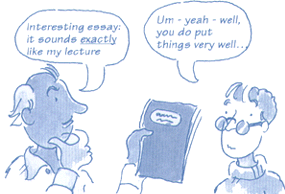
cartoon from http://www.palgrave.com/skills4study/images/plagiarism.gif
“cheating students” graphic from www.clipartheaven.com