
Purpose: This activity is designed for students to get a basic understanding of quantum numbers and then to use quantum numbers to write accurate electron configurations.
Task: Your task is to go to use the following websites and applets to examine the electron configurations of many elements and to identify the pattern that will emerge as you compare the Periodic Table to the electron configurations. Some of the websites will require Shockwave while others will require Java if you are to successfully read the websites. Click on the links to open the sites that will allow you to install the software. It is free of charge, but if you have a firewall or other blocking/protecting device, you may have to disable it for 5 minutes or so to get the software.
Some supporting information can be found in the Chemistry textbook written by Wilbraham, Staley, Matta, and Waterman in chapter 5. It can also be accessed by the students online at www.pearsonsuccessnet.com after signing up for this using the code provided in class.
Assignment: It is easiest if you print out the selection below so that you can record your answers on the printed page. However, if you do not have a printer or your printer is broken, you can record your answers on notebook paper, but you must record them neatly include the question or part of it in your answers. The answers to the questions will be submitted to your teacher for a grade. There is some reading involved in this site as I provide you with notes and some of the links to which you will be going provide you with reading information. The questions you need to answer are all in Red and bold font; instructions are all in Black font; and Notes are all in Marroon font.
Assessment: Most of the grade will be the completion of the following questions; however there are some questions to summarize at the end that will be partially graded on the correct answer. The assignment is worth 20 points of a homework grade.
Name ______________________________ Period ______ Date ______________________
Use your text, online text or the chart from the Acvanced Chemistry Topics (ACT) site from the Roanoke Valley Governor's School to make and attempt to defining the following quantum numbers. The chart is advanced and gives a lot of information, so there is no wrong answer here as long as you try to answer them honestly.
1.
|
Define the n quantum number.
|
2.
|
Define the l quantum number.
|
3.
|
Define the m quantum number.
|
4.
|
Define the s quantum number.
|
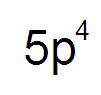
To help you further understand quantum numbers go through the activity created by T. G. Chasteen. Start with by entering 5 - p - 4 in the three successive boxes and read through the information in the activity as you identify the quantum numbers for that electron configuration. This may require Java and other software. Try some other configurations and play with this activity if you want.
5. |
What are the quantum numbers for
|
Some of the rules governing the combination of quantum numbers can be confusing; do not get lost on this, focus on the definitions and then just try a few for practice.
Go to the Chemical Rubber Company Press (CRC) website and take a quick look at the Periodic Table provided. This will help you to identify 4 distinct areas of the Periodic Table. You can click on elements if you want for specific information, but it is not necessary. All I want from this site is for you to see 4 sections of the table as it is broken into peices. These are important as they will help us to understand electron configurations.
When viewing any Periodic Table the elements are arranged in order of increasing atomic number as you go left to right, top to bottom. However, there is a funny jump in the numbering as you approach element 57 (lanthanum). To view the periodic table as it should be organized go to the American Chemical Society (ACS) website and click on the tab labeled "Electron Configuration". Click on several elements in each of the 4 sections you've identified a moment ago and try to identify them as s, p, d, and f depending on where the last arrow is drawn in the electron configurations that appear. (The last arrow will be the one closest to the top and furthest to the right.)
6.
|
Where is the s section of the table?
|
7.
|
Where is the p section of the table?
|
8.
|
Where is the d section of the table?
|
9.
|
Where is the f section of the table? |
Next go to the interactive applet created by W. Bauer where you can work with and build electron configurations from the ground up. This site requires Java. Note that each arrow represents ONE electron. to work the site, use the up and down arrows on the keyboard until you get to the element you want, or use the mouse to move the bar accross the bottom for quicker movement through the table.
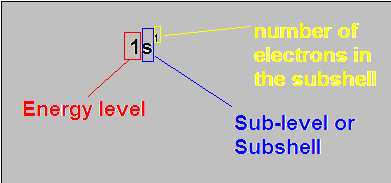
In order to write answer the next several questions, you need to know how to read electron configurations. Use the diagram to help you as you write the endings of the configurations in the questions.
To read the electron configuration of hydrogen.
Hydrogen has one arrow in the 1 energy level (located at the left of the screen) in the s sublevel (located at under the line where the last arrow appears). The notation would be:
1s1
10.
|
Identify the ending (last arrow in the highest energy level) for lithium, sodium, potassium, and rubidium. What are the configurations?
|
11.
|
Look at the location of these elements on the Periodic Table (use your agenda book or use the CRC table). What is the connection between the endings to the configurations you listed in question 10 and the location on the table?
|
12.
|
Record the endings for neon, argon, krypton, and radon.
|
13.
|
What is the pattern for their location on the table?
|
Now go to the website for another configuration applet. This one is interactive only to the point were you can advance the animation by clicking, but you cannot go back until the entire show is finished.
http://chemmovies.unl.edu/ChemAnime/ECONFIG/ECONFIG.html
This site requires Shockwave.
If you do not want to use that site you can use the site by David Rea at the University of Colorado as an alternative. This one requires Java.
14.
|
After viewing all of the applets and the CRC breakdown of the table, summarize the pattern that can be identified comparing the electron configurations to the Periodic table.
|
Notes: At this point I will summarize some of the things you have witnessed.
First there are 4 quantum numbers.
Each orbital can only hold 2 electrons spinning in opposite directions as shown by the up and down arrows in the applets. This means that each sublevel can hold 2, 6, 10, 14 electrons in the s, p, d, and f sublevels respectively.
Rule number ONE in all of chemistry is GAIN STABILITY. All chemical reactions occur in order to gain stability. In terms of the electrons they are most stable in the ground state or lowest possible energy.
This means that we fill the lowest energy levels first.
However, as the number of energy levels and sublevels increases it becomes complex enough so that the energy levels overlap.
When writing the configurations we start with the lowest energy level or with the noble gas that comes before the element in question. For example to write the electron configuration for sodium (you should have noted the ending for this earlier), we start with the lowest energy and work our way up.
1s2 2s2 2p6 3s1
We do this because sodium’s highest energy electron is in the 3s sublevel as noted by the applets earlier. Before we can get to that point we must fill the lower energy levels first. Note that if you count the number of electrons (the superscripted numbers) you see 11 as we account for all of sodium’s electrons when sodium is in a neutral state.
Note further that if we highlight part of the configuration we see that of a noble gas.
1s2 2s2 2p6 3s1
Where 1s2 2s2 2p6 is the configuration for Ne.
Therefore we can write the configuration for sodium with the following notaion:
[Ne] 3s1
Another example is Alumium:
1s2 2s2 2p6 3s2 3p1 or [Ne] 3s2 3p1
(note: aluminum does not fill the 3p sublevel so we stop at its ending point)
15.
|
Using either applet, find the electron configuration for Copper (Cu). Does this one fit the pattern that you noted in the rest of the activity?
|
16.
|
Write the electron configuration for bromine in both the full version and the shorthand using the noble gas.
|
17.
|
Write the electron configuration for zirconium in both the full and shorthand versions.
|
18.
|
Write the electron full configuration for lead. (You must try this for credit, but it is ok if it is not perfect.)
|
 ?
?