Chemical reactions are a part of everyone's life everyday. Most of us do not even realize the reactions that occur around us. Our cars run on a combustion reaction as fuel is reacted with oxygen to generate heat. This heat is used to move pistons which in turn turn a crank and run our engines. This is one of many very important reactions that occur daily. In this activity the you will be asked to study some chemical reactions, learn to recognize them, and finally write and balance them using chemical symbols as well as pictorial symbols.
Purpose:
- To use the Law of Conservation of Mass to write and balance chemical reactions accurately.
- To work with the periodic table and identify the molar mass of chemical formulas.
Task:
In this activity you will examine and use several web resources to read about, learn about, write and balance reactions. Part of the activity does require the use of Shockwave on the computer. If this software is not on your computer, it may be downloaded at no cost by clicking on the link provided. To download properly the user will need to disable firewalls for the duration of the download.
Assignment:
For this assignment you will need to print (or copy to notebook paper) the questions provided by this site and use the links throughout the activity to answer the questions. These will be collected by your teacher.
Scoring:
Some of the activity practice and will be graded on completion. However, the questions associated with the reading sections questions in which you are asked to write or draw reactions and questions dealing with mass calculations may be graded for accuracy. This assignment will be recorded as a homework assignment unless your teacher indicates otherwise.
Instructions:
Go to the following links and answer the following questions. Print the questions out or copy them into notebook paper to be turned in to your teacher. If your computer has Flash Paper, then you can click here for a more printer friendly version of the following section.

Name ________________________ Period ______ Date __________________
For the first part of the activity go to the website written by Anthony Carpi and read the first few paragraphs (down to the water molecule piece that you can click on to view).
1. What are the two things wrong with the following reaction?

a.
b.
Read a bit further.
2. What does it mean when it reads "balanced"?
Stop reading when you get to the example for the combustion of methane. Click on the water simulation and watch the video clip. Watch carefully as you will be asked to draw something similar to this before the end of this activity.
Application of Concepts
3. What role does the Law of Conservation of Mass play in writing chemical reaction?
Exploring Further
Go to the Wong website. (Here is were you will need Shockwave ). Follow the tutorial.
4. Record the steps required to "balance" a reaction
a.
b. (hint: the reactants are on the left side of the reaction arrow)
c. (hint: the products are on the right side of the reaction arrow)
d.
e.
f.
Go to the left side of the screen and click on the "Exercises: Combustion" section or click here to go direction from this site.
5. Pick any one of the 4 choices for combustion reactions and show how you balanced it.
Try the other combustion exercises for practice. You can also practice with the "Exercises" section on the left of the page as there are 10 reactions that are not combustion reactions with which to work. (if you want extra practice with some of the math we have done in the class you can practice with the "Dimensional Analysis Exercises" at your leisure at another time.)
Go back to the Anthony Carpi website. Read about the combustion of methane (where we left off earlier). This may be the same reaction you wrote in question 5 if you chose methane.
6. Try the practice problems. How many did you get correct on the first try? Be honest here as you would only be cheating yourself.
You are viewing the chemical reaction with their respective chemical symbols. I would like you to draw some of them using visual representations of the atoms involved. Below you will find a picture for the reaction of water that we witnessed at the start of this exercise
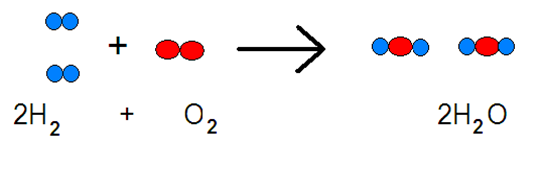
7. Draw a similar image representation for the first reaction in the Carpi site: the synthesis of NaCl.
8. Draw a similar representation for the synthesis of ammonia (NH3).
9. Draw a similar representation for the synthesis of rust, iron (III) oxide (F2O3) - this one is more difficult and is not graded on accuracy.
For a more colorful practice with balancing reactions, go to the site written by Richard Bowles. Read through this site and try the practice problems at the bottom.
10. Again be honest, how many did you get correct on the first try?
Again go back to the Anthony Carpi website at read the Mole and Molecular Mass section below the practice problems.
11. What is a mole in chemistry? What is its value?
12. Steps are provided and an example shown as the molar mass of water is calculated. Use those steps to find the Molar mass of the following, SHOW ALL WORK FOR CREDIT:
a. NaCl
b. NH3
c. F2O3
Summary:
In this activity you have explored chemical reactions and have written and balanced them. You have also worked with the mole concept and have used the Periodic Table to write formula masses. We will continue working with these in class and will also perform some laboratory investigations were we will apply these concepts.